
What we can learn about internal expenditure when harvesting energy.
Ultimately, we are meant to be Sovereign Travelers through life. We wake up each morning, hopefully from a restful, dreamy sleep, and begin our day as independent operators.
But along the way, we lose our efficiency. We get tangled in legacy code, and our internal electrical grid begins to red-line.
Recently, I decided to tackle the installation of a new smart controller in my mobile solar power system. Technology has advanced significantly since my initial install of panels, wiring, and batteries back in 2014.
In those early days, the system was fragile, high-resistance, and easily compromised. If a slim shadow—even a single overhanging branch—were to fall across a fraction of a panel’s surface area, the delivery of power to the controller would instantly drop to zero. The entire circuit would stall.
Clever modern engineering has changed the game. It is why an upgrade is so vital. The new Victron controllers sense the micro-changes in the atmosphere—even a passing, high-altitude cloud—and via a kind of digital alchemy, they instantly rearrange the internal circuitry so power continues to be harvested. It is not the blinding current of a perfect, blue bird-sky day, but it is a hell of a lot more than zero. It is adaptive. It possesses structural integrity.
You can monitor the rhythm of the day on a phone. The sequence tells a story:
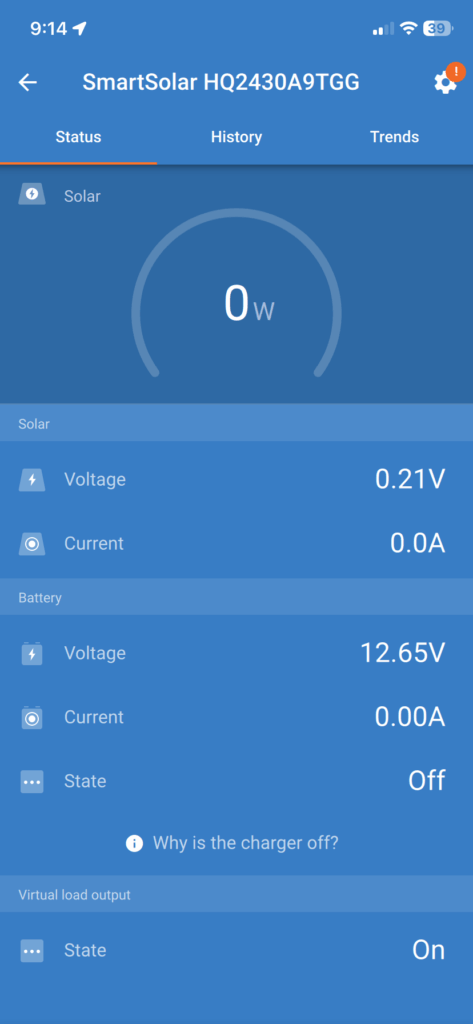
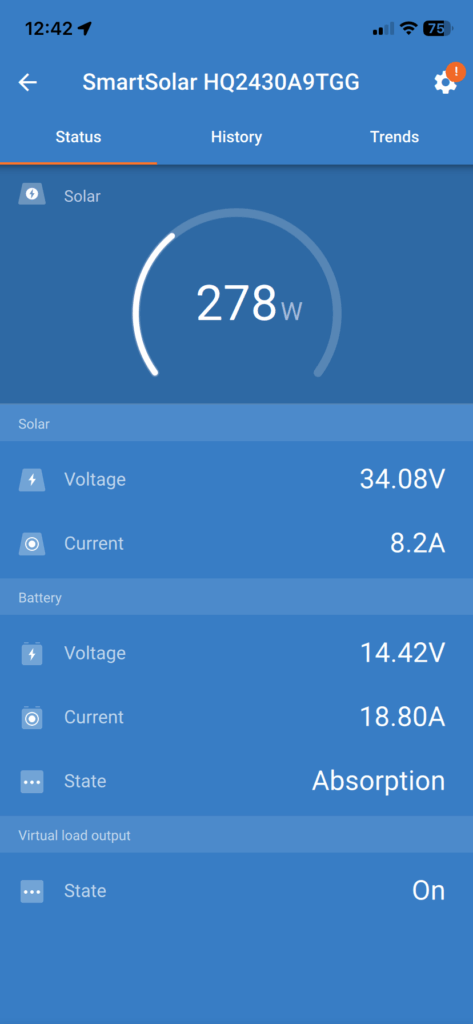
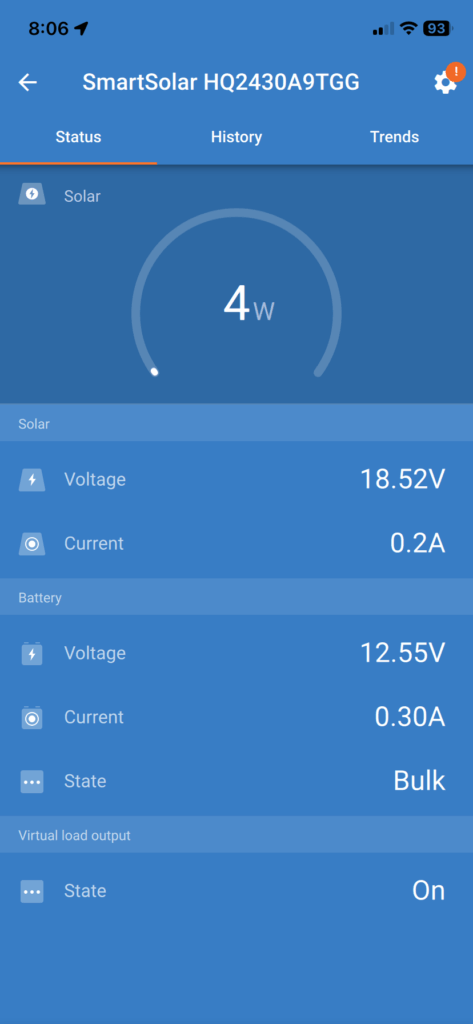
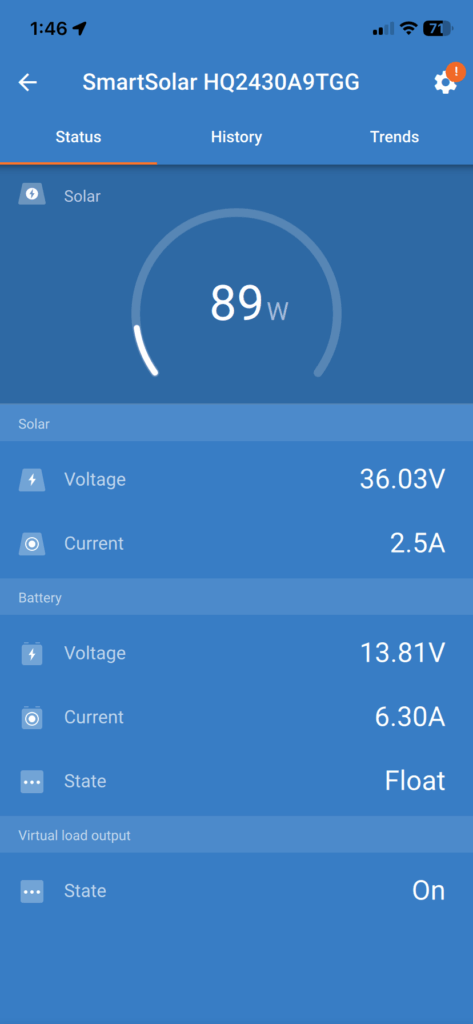
The Architecture of the Internal Controller
The life lesson in this blue-and-white interface is a perfect analogy for human energy.
The inner Buddhist in all of us would recognize this calibration. It is the wisdom of knowing when to drop into “Float” instead of forever striving in high-RPM loops that disallow Stillness.
Our internal controllers get stuck. We make enough money for the day, yet we refuse to sit back. We tone our muscles just fine, yet we refuse to rest. We chase a conversation or an achievement long after the battery is already at 100%, creating parasitic drag and thermal overload.
What a beautiful world it could be if each of us honored our inner Controller—one that perhaps we never realized we had, or one that has rusted up from decades of neglect.
It is time for a firmware upgrade.
The Parenting Paradox: Forgetting How to Float
Let’s explore where our controllers first begin to fail us. Consider the shift into parenthood.
When you bring up a child, you are thrust into a decade-long “Bulk Charge” phase. A newborn requires maximum current, 24 hours a day. You are constantly monitoring, correcting, and expending energy to keep another human system alive. You learn habits of hyper-vigilance. You become a highly efficient, high-resistance machine out of absolute necessity.
The trouble is, habits persist.
Years pass. The child grows up, becomes an independent sovereign traveler, and walks out into their own horizon. But the parent’s internal controller remains jammed in “Bulk” mode. We forget how to scale back the voltage. We look at an empty nest or a quiet afternoon, and instead of dropping into a beautiful, steady Float, our nervous system continues to frantically scan for a load to carry. We have become addicted to the strain. We have forgotten how to sit in the stillness of a full battery.
The “Love-Based Responsibility” Trap
The reason it’s so hard to “let go” is that the rushing feels like Proof of Love. In the “Legacy Code” of parenting:
- Velocity = Care.
- Stress = Commitment.
- Stillness = Negligence.
The Heart with No Companion
This systemic failure becomes most acute when we are forced into the ultimate decompression event: the Heart with No Companion.
When a long-term partner passes away or leaves the grid, the emotional damage isn’t just grief—it is a massive structural shock to the circuit. For decades, that companion was your “Ground.” They absorbed your static, shared your electrical load, and provided a reference voltage.
When that ground is suddenly ripped away, your heart is left un-terminated. The signals of love, routine, and care that you used to broadcast into the room have nowhere to land. They bounce back, creating chaotic internal interference.
If your inner controller is rusted out, your posture reflects the system failure. The shoulders round forward, collapsing inward to protect a vulnerable, short-circuiting heart. You are pushing against a phantom resistance, straining into a gale-force wind that has already fallen dead calm.
The work of the Sovereign Traveler in that dark space is not to frantically search for a new connection to plug into. The mahi is to allow the system to drop into Float.
To sit quietly with the missing link, to let the internal circuitry rearrange itself—just like the Victron under a passing cloud—and to realize that you can still harvest light in the quietest, coldest weather. You don’t need a hostile takeover of the world around you. You just need to look up at the hills, take a breath of still air, and let the controller do its job.
Footnote from the Field Guide:
“For those navigating the phantom resistance of an un-terminated grid, let the poem be the regulator. Being a soul without a king isn’t about isolation; it’s about becoming the sole operator of your own circuit.”
Now god bless the soul without a king
Who is called upon to stand
Who got no validation
In the high places of the land…
Heart with no companion
Kindred to the hurt
Ask the tiny sparrow
How much the feathers hurt…
— Leonard Cohen

Postscript: The atmosphere has its own timing. The images of the sun dropping through the inversion layer were captured fresh between paragraphs. A glance out the door revealed the horizon doing exactly what the pen was trying to describe: filtering the static, slowing the RPMs, and dropping completely into Float.